Research Lab for
Concrete Utopias
WRITING FROM THE LAB
Publications
The Lab’s writing: the doctoral thesis its framework comes from, and texts that grow out of its projects.
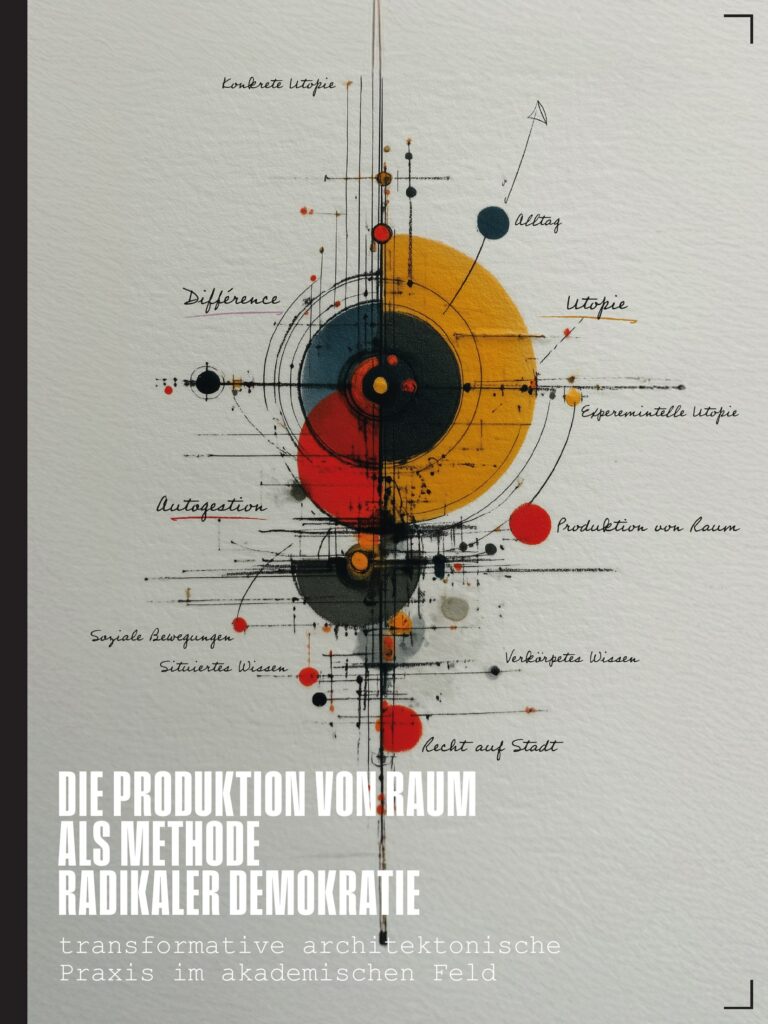
DOCTORAL THESIS · 2026
Die Produktion von Raum als Methode radikaler Demokratie
Transformative architektonische Praxis im akademischen Feld
English title: The Production of Space as a Method of Radical Democracy: Transformative Architectural Practice within the Academic Field
Xotil Natke · Dissertation (Dr. techn.), University of Innsbruck, Faculty of Architecture · Supervisor: Eric Sidoroff · Submitted October 2025, completed 2026 · 420 pages, in German
Abstract
This dissertation departs from a political and spatial present in which urban spaces increasingly become sites of collective contestation and social struggle. Social movements—such as feminist initiatives, anti-gentrification and housing movements, anti-racist and queer activism, as well as anti-tourist and ecological protests—intervene in existing spatial orders, generating distinct forms of knowledge, aesthetic practices, and modes of social organisation. These movements not only produce resistance but also generate tangible impulses for transformation that can be relevant and productive for architectural practice—particularly within academic contexts.
The work questions how an architectural practice situated within academia can learn from these social struggles, open itself epistemically, and unfold its political and social potentials. Architecture is thus not primarily understood as a design discipline, but as a socially situated field of action capable of analysing, questioning, and actively transforming real-world conditions. The focus lies not on form, but on the production of space as a social and relational process—a perspective largely derived from Henri Lefebvre’s spatial epistemology, yet expanded through the inclusion of diverse actors toward a contemporary reading that foregrounds feminist, decolonial, and everyday dimensions of spatial production.
Three guiding concepts structure the conceptual framework of the thesis, intertwining theory, practice, and transformation: the right to the city, the concept of difference, and the production of space as methodology. The right to the city functions as a normative foundation, articulating the collective right to participate in urban spatial production. The concept of difference opens the theoretical framework toward epistemic plurality and situated knowledge. Finally, the production of space provides the methodological basis through which social struggles, affects, and practices become visible and tangible as space-forming processes. Within this structure, three pillars unfold: #autogestion as collective self-organisation, #différence as the productive recognition of plural knowledges, and #utopia as a speculative tool for opening experiential spaces of possibility.
Lefebvre’s trialectics of space—as perceived, conceived, and lived—does not serve as a starting point but as an instrument for generating a differential space that remains situational, collective, and open.
In its empirical part, this framework is further developed through a two-year pilot study carried out in Zaldibia (Basque Country) in collaboration with the University of Innsbruck (Studio 2), the University of the Basque Country (EHU), local institutions, and over seventy participating students. Building on the preceding chapters and drawing on various references—such as Atelier d’architecture autogérée, Architectural Behaviorology, raumlaborberlin, and Arquitectos de Cabecera—the study unfolds in three phases: the generation of inter- and transdisciplinary knowledge formats, experimental 1:1 interventions, and a collaboratively developed design process in which architecture was understood as a contextual and conflict-capable process of collective spatial production.
The dissertation advocates for an academic architectural practice that engages with social tensions and cultivates political agency rather than outsourcing it—a practice that learns to be affected, to move, and thereby contributes to the realisation of radically democratic lived spatial productions.
Chapters
- 01 Kontext: Urban conflicts as political space: how social movements treat space as both the site and the material of their struggles, and the research question that follows from this.
- 02 Haltung: Henri Lefebvre’s spatial epistemology, his triad of space, espace différentiel and everyday life, extended through feminist, decolonial and everyday theories.
- 03 Framework: #autogestion, #différence and #utopie as the three guiding concepts of the work.
- 04 Methodologie: Principles of a transformative architectural education, developed from international reference projects and teaching formats, including the 2020 studios Gestaltung 1 and Studio 2.
- 05 Pilotstudie: “From the Edge to the Center” in Zaldibia: two years of collective design with the municipality, local actors and students, in three phases.
- 06 Outcome: The institutional tensions of practising a transformative methodology inside the university: ambition and feasibility, autonomy and curriculum, collectivity and grading.
- 07 Epilog: Architectural education as a place of negotiation, and space as a shared, collective and political practice.
Read the research framework → · The pilot study: From the Edge to the Center →
For a copy of the thesis, write to info@rlcu-arch.org.
Have a place that needs a concrete utopia?
We work with municipalities, civic groups, cultural institutions, universities and building partners on studios, 1:1 interventions and joint research.
Research Lab for Concrete Utopias
Institut für Gestaltung / Studio_2
Faculty of Architecture, University of Innsbruck
Technik Campus, Technikerstraße 21
6020 Innsbruck, Austria